Friday, March 10, 2023

Game Location Types in Plates Across America®

Location Icons in Plates Across America®

As you solve the word puzzles in Plates Across America®, you (virtually) travel along various routes across the country and visit thousands of interesting locations. In the game, we have created a number of different types of locations which have special significance. 

Some of the location types are the basis of the game's "Travel Goals" that help you win the game, while other types will unlock extra game features. Here we give an overview of all the various location types found in the game.

Collectible Location Types

To win the game, you must achieve 63 travel goals to complete building your flag (13 stripes + 50 stars = 63). Some of these travel goals require visiting a certain number of given location types. For example, visiting 25 state capitals, 10 caves, 5 ghost towns, are some of the possible Travel Goals. (You can read more in our Travel Goal Blog Article.)

Collectible Location Type Icons in Plates Across America®

Below are the 9 different collectible location types that serve as the basis for Travel Goals. The image to the right shows the icons we use to represent these location types:

  • Bridges
  • Caves
  • Ghost Towns
  • Mountain Passes
  • National Monuments
  • National Parks
  • State Capitals
  • Tunnels
  • Waterfalls

Remaining Location Types

There are dozens of other types of locations, many of which will unlock a "Lightning Round" when visited. (See our Lightning Round Blog Article for an explanation of that feature.)  A few of the more interesting ones and their icons are shown below.
Plates Across America® Location Type Icon Highlights

In all, there are 44 different types of locations in the game. Here's the full set of them along with the icons we use to represent them.
All Location Type Icons for Plates Across America®

Conclusion

We hope this gives you a little extra insight into Plates Across America®.  There's a lot of design and data work that went into creating these location types and though this is not a prominent feature of the game, we feel that these subtle additions are important in giving the game more visual appeal.

If you have not played our game before, try it out here for free:

Happy Travels!

Friday, December 16, 2022

Lightning Rounds

Plates Across America® lightening rounds
With the revised version of Plates Across America®, we introduced a new feature we call "Lightning Rounds".  This gives you 5 additional puzzles to solve to get some extra points, but there is a catch: you have a limited time in which to solve each puzzle. The effect of adding a timer changes the dynamics of the game considerably.  The brain is a funny thing: time pressure tends to reduce how well it works.  

History

Before we released the game to the public, the timed puzzle concept was in consideration for use in the entire game. We experimented with various timer durations and found as they got shorter, the anxiety it produced for players was sometimes overwhelming. Some people would get visibly upset and seriously stressed and this was just playing a demo of a game.

Plates Across America® lightening rounds
We eventually abandoned the timer for the main single-person game, though we retained it for the two-player game. A timer is necessary in multi-player games or else you potentially have one player getting frustrated with the slow play of the opposing player. However, with our latest redesign, we have re-introduced the timed feature for the single-player game, though in this limited way with these Lightning Rounds.

Lightning Round Triggers

The Lightning Rounds will show up when you reach some types of interesting locations: tourist towns, quirky roadside attractions, hot springs, etc. You can now choose to accept this adrenaline charged challenge, or decline it each time it is triggered. By playing the Lightning Round, you can accumulate more "ride points", which you can use to customize your vehicle. You can also choose to stop the Lightning Round notices from appearing to you.

Plates Across America® word game

Duration of a Lightning Round

You are given the choice of 3 levels for the Lightning Rounds from hardest to easiest, where the amount of time determines the difficulty.  The less time you choose, the more ride points you can earn.

If you have not played our game before, try it out here for free:

Happy Travels!


Saturday, December 10, 2022

Route Number Signs Add to the Travel Experience in Plates Across America®

Plates Across America® NM Route Number
New Mexico
In Plates Across America®, we want the game to give players a true sense of traveling. We've added a number of features and visuals to help achieve this, including the route number signs you would see as you traveled. This was a painstaking process of both creating the images and assigning the proper route numbers to each portion of each route.

Types of Route Number Signs

There are 3 main levels of route number signs in the U.S.

  • National - There are only a handful of these: U.S. routes, interstates and business routes. There are also a few miscellaneous ones for national park roads, national forest roads, etc.
  • Plates Across America® route number
    County Road Sign
    State - Each state defines their own route signage, so there are 50 variations needed. Some are elaborate, some very simple and many in between. And in some states, like Texas, they have a lot of variations depending on what type of road it is designated (e.g., ranch road, farm to market).
  • County - There is a county-wide standard for what county road signs should look like, though this has not been universally adopted. For the sake of the simplicity, in the game, we assume all states have adopted this standard.

Designing Route Number Signs

Plates Across America® FL route number
Florida

When considering national, state and county road signs, we ended up with 68 variations. However, this is just the number of different "styles" of signs and each of these can have hundreds of different route numbers appearing on them. If we were to create a different image for every possible combination of style and number, we would need to create many thousands of images. Just creating the 68 styles would be time consuming enough for us.

Our solution to reduce the number of images was to use a Scalable Vector Graphic (SVG) for the style and then use the SVG layering ability to drawn text characters on top of it for the route numbers. The route numbers could be anywhere from 1 to 4 characters, so the font size and position would need to be adjusted depending on the number of characters. Fortunately, the SVG format gives some help in allowing us to do this, so it was less tricky than it could have been.

The other big consideration that the SVG helps us solve is web site responsiveness. Scaling images and especially fonts to all the device sizes out there is important for the game's playability.

Assigning to Routes

Plates Across America® MN route number
Minnesota
Plates Across America® has nearly 350 different routes, however, these are the game's concept of "routes" which are not the same as real life routes. In fact, a single game route may traverse many different (real) route numbers. We needed to go through each of the game routes and find all the route numbers that have to be assigned for each segment of the route.

We used Google Maps to find the real-life route numbers and our internal route editing tools to encode them in the game. Interestingly, Google Maps has a similar problem in showing route numbers for states and counties, though they chose *not* to use different styles for each state like we do. When you look at Google Maps, round circles are state route numbers, while square route numbers are county roads: this is true for all states.

Plates Across America® CO route number
Colorado

When we encoded the route numbers in our editing tools, we used a convention of combining the "style" (e.g., state) and the route number. For example, "i-95", "tx-2222", "ca-1", "county-34a".  Our software would then parse the style from the number, choose the right style SVG and then render it with the text of the route number depending on how many character were in he route number. In order to have the number fit into the image boundary, we have to scale down the font size more for a 4 digit route number than for a single digit one.

Conclusion

We put quite a lot of effort into these route number signs even though they are not a major part of the game. However, we felt that in order to recreate a real sense of traveling in the game, a lot of these small and subtle details needed to be included.

If you have not tried our game before, 

Happy Travels!

Plates Across America® Route Signs


Tuesday, December 6, 2022

Plates Across Americe's® Badges and Achievements

Achievements Page
Achievements Page

When you play Plates Across America®, you will earn "badges". Some of these are directly related to the single-player game's Travel Goals, some are earned for achievements in the two-player game and a few others for players that make contributions to the game.

Since it takes a while to accumulate all the different types of badges, we thought it might be interesting for newer players to see the full set of our badges and to find out how each one is awarded. We add new badges from time to time, so there may be new ones by the time you read this article.

Achievement Levels and Coloring

For all the badge types, there is a range of achievement levels. These levels will correspond to some minimum value needed to earn the badge.  As you reach higher threshold values, the color of the badge reflects the increasing achievement level. The coloring scheme for the achievement levels is shown in the image below for the Miles Traveled Badge.

Types of Badges

Miles Traveled Badges

We start with the simplest one to understand: the miles traveled badge. This is based on the total number of miles you have traveled while playing the single player mode. The achievement level thresholds for this badge are 100, 250, 500, 1000, 2500, 5000 and 10000 miles.

Miles Traveled Badges

Collection Badges

The core concept for winning the single player mode is the "Travel Goal". You can earn Collection Badges as you reach travel goals. Examples of travel goals are:

  • states you have traveled through;
  • license plates you have collected;
  • scenic routes you have traveled; and
  • locations you have visited for the different "location types".

Here are examples of some of the badges you can earn as you achieve travel goals.

Collection Badges

Location Badges

As you travel in the single player game, you pass through (or near) cities, landmarks and other man-made, natural and geological places of interest. You can collect these places to reach different Travel Goals. The kinds of places you can collect include:

Location Badges
  • state capitals, 
  • national parks, 
  • national monuments, 
  • bridges, 
  • caves, 
  • ghost towns, 
  • mountain passes, 
  • tunnels, and
  • waterfalls.


Two Player Game Badges

When two players compete against each other, we call this a "Race". In a race, each player is given the same 10 puzzles. There is a time limit for each puzzle. The player that enters the best answers wins the race. You can get badges for competing in and winning enough races.

Two Player Game Badges

User Contribution Badges

The final set of badges we have are not for in-game achievements, but are for players that have helped improve our game. There are a few ways users can help to improve the game:

Dictionary Words

Dictionary Badge

It is more challenging than you might think to build a good dictionary, and even harder to get a large group of people to agree what should and should not be included in a dictionary. Therefore, we acknowledge that at any point in time, our dictionary will not be complete and it will evolve. Because of this, players can suggest words to be added to our dictionary.  

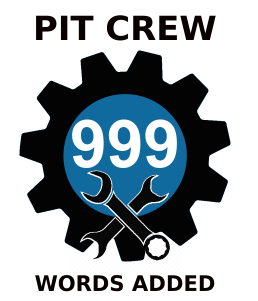
When your answer is flagged as being incorrect because it is not in our dictionary, we provide a link you can use to submit it to us. We review these submissions and if the word is accepted and added, we acknowledge your contributions with the "Pit Crew" badge.

City Facts Badge

City Facts Badges

As you travel in the single player game, your pass through and near cities, towns and other locations of interest. To add to the feeling of virtual traveling and to provide players with some interesting context on the places being visited, we have a "City Facts" feature that gives some interesting trivia, facts and history of the locations. 

There are tens of thousands of places across the country, so it is hard to know about each and every one of them.  However, if a player is acquainted with the area, they may know something interesting about it that we do not. In the game, we allow players to contribute and share that knowledge by sending it to us for review.  We will research the suggestion and if it is accepted, we acknowledge the effort with the "Historian" badge and also give attribution to the person that submitted it. 

Early Adopters Badge

Early Adopters Badge

Plates Across America® has evolved a lot since the early versions. We constantly iterate to make the game better and better. We can only do that by having real players try out the game and give us feedback.  Some give us explicit feedback, while others provide it indirectly by what they do and do not do as they play the game.  

To thank those people that have played earlier versions, we give them the "Trailblazer" badge.  The earlier a player joined, and the more they have played, the higher the badge level.

Closing Comments

We hope this overview of the game's badges was informative.  If you have never played Plates Across America® before, you can start acquiring badges by playing here:

https://platesacrossamerica.com

Happy Travels!

Monday, October 31, 2022

Earn Travel Goals to Win in Plates Across America®

Travel Goal Icon

As you play Plates Across America®, you can win the game by reaching a series of "Travel Goals". Examples of Travel Goals are:

  • collecting 25 license plates;
  • visiting 10 states; 
  • traveling 20 scenic routes; and
  • visiting 50 national parks.

Travel Goal Types

There are 12 types of Travel Goals:

Bridges, Caves, Ghost Towns, License Plates, Mountain Passes, National Monuments, National Parks, Scenic Routes, State Capitals, States, Tunnels, Waterfalls.

Travel Goal Levels

Within these types there are 8 "levels" of achievement based on the quantity collected.  The quantities for each type can vary depending on how many appear in the game. For example, since there are more bridges than states, the levels for bridges are 1, 5, 10, 25, 50, 100, 150, 200 while for states it is 2, 5, 10, 15, 20, 30, 40, 50.

Winning the Game

Travel Goal Icons

If you do the math, there are 96 possible Travel Goals in the Plates Across America. Because the game has many routes to choose from, the routes you choose will dictate which travel goals you can achieve. When designing the game, we did not want "winning" the game to consist of reaching all 96 Travel Goals. We wanted to give you choices about what routes to travel, not to require you to travel all of the routes. 

The game also has a leader board to show who has reached each Travel Goal first. If we required reaching all the Travel Goals to win, then everyone would need to take every route, with no freedom to choose how they want to win.

Therefore, we designed the game so that you only need to reach a subset of all those goals to win. Specifically, we require 63 goals to win the game. Why 63?

Travel Goal US Flag

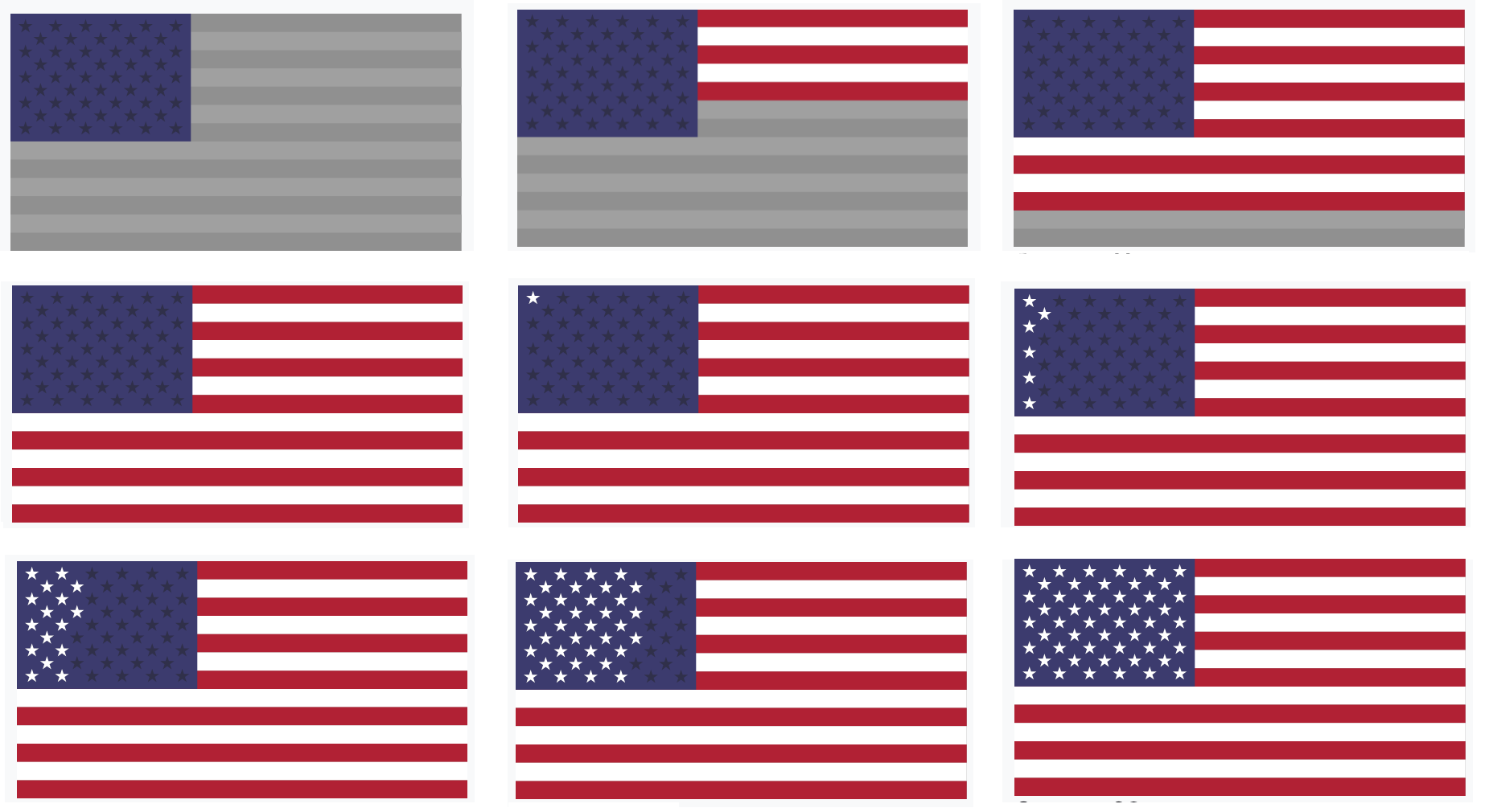
We wanted to provide a fun, visual representation of a player's progress in the game. Sticking with the "America" theme, we landed on using the American Flag. Each star and stripe represents one of the Travel Goals, and that is where the game winning number "63" comes from (13 stripes + 50 stars = 63).  The flag starts greyed out and the color changes as you reach each travel goal. When you win, the flag will be red, white and blue.

Progress in travel goals icon

In case you are thinking of asking: yes, we would have to revise the game if more states were added to the union.

Disrespecting the Flag?

Although the U.S. Flag Code is included in Federal law, it is not mandatory, uses non-binding language and prescribes no penalties for violating it.  Thus, it is more of a suggested "guideline" than it is an enforceable "law". While not being fined and not having the threat of jail time is a comfort for us, we still do not want to offend anyone: we just want to provide a game that is fun to play and we are not in the business of making political statements.

Whether we are being disrespectful according to the U.S. Flag code depends on how strictly someone wants to interpret it. Ever see an American Flag in a Budweiser commercial or on one of their beer cans?  Ever use a paper napkin or plastic cup with a flag on it at a Fourth of July party?  Ever seen an American flag patch on a baseball player's uniform? These are deemed disrespectful and against the rules according to a strict interpretation of the U.S. Flag Code. 

In our experiences, people do not seem to be offended by many common uses of the flag that could be considered in violation of the U.S. Flag code. How many people even know that using a flag on a paper napkin is contrary to the U.S. Flag code?  

Therefore, we have chosen not to follow the strictest interpretation of U.S. Flag code. Even the American Legion, who were the drivers of establishing the U.S., Flag code (in 1942) had this to say about the use of the American flag in clothing even though the code forbids it:

“People are simply expressing their patriotism and love of country by wearing an article of clothing that happens to be red, white, and blue with stars and stripes."

In the same spirit, Plates Across America® uses the American Flag as part of our game's theme with the aim of celebrating the excitement of traveling the many wonderful places across the United States of America.

Beyond Winning

When you reache 63 travel goals, you have won the game. However, if you are inclined, you can continue playing. You can travel all the routes and reach all the Travel Goals.

If you have never tried our game before, please try it out here:


Happy Travels!

Wednesday, October 19, 2022

Dictionary Improvements

Dictionary

We recently made some big improvements to the Plates Across America® dictionary. Our game's dictionary is the critical starting point for the word puzzles that appear on the license plates.

Starting State

Before the latest refresh, our dictionary had 99,857 words. This generated 14,900 unique word puzzles with a little over 8 million possible solutions across them. These numbers sound relatively good, but as you will see below, we needed an even better game dictionary.

We formed the initial dictionary from multiple non-commercial sources since we had a very limited budget when we first started creating the game. These "free" dictionaries all had some quality problems, so we opted to use them all in a "voting" scheme where we (conservatively) only included words that we saw appearing in multiple dictionaries.

In Game Improvements

Dictionary Badge

Because we took a conservative approach, we knew the dictionary had gaps, so we added a feature to allow users to suggest new entries from within the game. If the game flagged your answer as not matching (because it was not in our dictionary), you could click a link to notify us and we would then review it. We built tools and a process to review player suggestions and add them to the dictionary. We even added a special "badge" (at right) to recognize the player's contributions.

As more players joined the game, our queue of suggested dictionary additions got busy. Reviewing these confirmed our suspicion that we had gaps. We realized that the gaps might be bigger than we expected. The dictionary issues were becoming our biggest problem to address.

Dictionary Improvements

Since we first built the dictionary, we have found a few other freely available dictionaries. The best one we found had some issues of allowing some hyphenated words and capitalized words (proper nouns), which are not valid answers according to our game rules. However, the number of good words it had was significant, so we decided to take the bad with the good. We'll eventually remove the bad words, but we felt being more liberal about what is included in the dictionary was a better decision. Our first attempt was way too conservative.

Our resulting dictionary has 172,584 words. On first glance it looks like we added 72,727 (172,584 - 99,857). However, during the dictionary upgrade process, we detected 21,072 "bad" words in the original dictionary. Thus, this new dictionary source effectively added 93,799 new words: double the size.  This new dictionary bumped up the number of possible word puzzles to nearly 16,000 and the total solution count across them to just shy of 15 million.


Plates Across America

Conclusion

All in all, our dictionary was significantly transformed and improved with our latest efforts. For those that played our game and were flagged for wrong answers for valid words, we wish we could go back in time to prevent that, but at least we have made some strides to prevented it in the future.

If you have never tried our game before, please try it out here:

https://platesacrossamerica.com

Happy Travels!


Saturday, October 8, 2022

Designing the Vehicle Avatars for Plates Across America®

Initial vehicle avatars
The vehicle styled avatars in our game was one of the last big features we added before we undertook our recent, major redesign. Not only can you choose which type of vehicle you want other players view for you, but you can also customize your avatar with different paint colors, accessories and modifications. Many players liked the vehicle avatars so we did not change it at all when we recently relaunched with our new version of Plates Across America®.

Back when we added this feature, we created 16 vehicle types since we wanted to give you a wide variety of avatars to choose from. We still have a long wish list of vehicles we want to create and add. In the coming weeks, we plan to add a number of new vehicle types, so stay tuned as we roll them out. These will all be fun additions to our vehicle avatar choices.

Below, we give a brief "behind the scenes" look at the process we use to create these vehicle avatars.

Designing the Avatars

Idea Phase

Cars, bikes and trucks are rich areas for ideas, especially when you consider not just the contemporary offerings, but all the vehicles throughout history. There are also appearances in popular culture to add to the richness of choices. Thus, coming up with the initial ideas is easy, but there are some limitations to consider:
  • Variety - we do not want to have avatars that are highly similar, so we try to find a "category" or "type" that is distinguished from the others.
  • Copyright - as much as we would like to offer avatars like the Batmobile or other vehicles from popular culture, we also very much like not being contacted by lawyers with cease-and-desist letters or seeking royalty payments.
  • Priority - we needed to consider which vehicles will have the most appeal and interest for players.

Sampling Phase

Once we have settled on the type of vehicle, we hunt around the Internet (usually using Google's image search) for examples fitting this genre. We do not use these images directly, but they serve as inspiration for our avatar drawings. We look for images showing a nice clean side profile as that is how all our avatars appear. We sometimes need to horizontally flip the images as our avatars face to the right.

Drawing Phase

We use the open-source program Gimp to do the design (it's like Photoshop, only better). The trickiest part of the design work is planning the "layers".  

We use the Scalable Vector Graphics (SVG) format to render the avatars on our website and Gimp supports this with its "path" feature. The SVG format is more flexible that using plain old GIF, PNG or JPG images and it allows us to more easily provide the customization feature. We actually use multiple SVG images, one on top of the other, so that we can "insert" an accessory or change color. For example, look at our convertible avatar below:
Blue Convertible Vehicle Avatar
Notice the black door guard band across the body. When you change the color of the car, we want only the body to change color and not the door guard, i.e., we want this:
Yellow Convertible Vehicle Avatar
We achieve this by putting the body drawing on one layer and the door guard on a layer above it. Then we can change only the body color, redraw and the black body guard is rendered over the body's yellow coloring.  

This layering approach is a common pattern used in most design software, including Gimp, so we are able to create each SVG layer in its own Gimp layer. Notice that the rear view mirror of the vehicle is also in the upper layer and gets drawn over the body color too.

We also have to consider the customizable accessories for the vehicle when we plan out the layers. For example, adding purple stripes like this:
Yellow Convertible Vehicle Avatar with accessory
means we need another layer between the body and the door guards since you probably would not paint stripes over the rubber door guard in real life.  When a vehicle has lots of different accessories, the layer planning gets more complex.

Coding Phase

We then use the "export path" feature of Gimp to output a separate file for each SVG layer. These files will become part of our source code. Inside our code, we maintain a list of all available vehicle types and what accessories it has. We add the new type to that list, its accessories and include the names of all the new SVG files. We also set the game cost for the vehicles (in "ride points") and decide at what point in the game the new vehicle will be "unlocked" and available. Vehicles get unlocked in groups as you reach milestones, so here we determine which group it should be in.

Van Vehicle Avatar

We have a special vehicle test page which allows us to view the result and visually verify it before we make them part of the next game release.  An important part of this visual verification is to make sure the left-facing, mirror image looks correct.  In our two-player game, we render the player's avatar in the default right-facing view, but their opponent is mirrored so that the avatars appear facing one another.

Conclusion

We hope this glimpse into the design process for our vehicle avatars was interesting. It can sometimes be a tedious chore to draw out all the layers of a new vehicle, but it is always exciting at the end when it all finally comes to life as a new avatar choice in Plates Across America®.

If you have never tried our game before, please do here:


Happy Travels!