Showing posts with label design. Show all posts

Saturday, December 10, 2022

Route Number Signs Add to the Travel Experience in Plates Across America®

Plates Across America® NM Route Number
New Mexico
In Plates Across America®, we want the game to give players a true sense of traveling. We've added a number of features and visuals to help achieve this, including the route number signs you would see as you traveled. This was a painstaking process of both creating the images and assigning the proper route numbers to each portion of each route.

Types of Route Number Signs

There are 3 main levels of route number signs in the U.S.

  • National - There are only a handful of these: U.S. routes, interstates and business routes. There are also a few miscellaneous ones for national park roads, national forest roads, etc.
  • Plates Across America® route number
    County Road Sign
    State - Each state defines their own route signage, so there are 50 variations needed. Some are elaborate, some very simple and many in between. And in some states, like Texas, they have a lot of variations depending on what type of road it is designated (e.g., ranch road, farm to market).
  • County - There is a county-wide standard for what county road signs should look like, though this has not been universally adopted. For the sake of the simplicity, in the game, we assume all states have adopted this standard.

Designing Route Number Signs

Plates Across America® FL route number
Florida

When considering national, state and county road signs, we ended up with 68 variations. However, this is just the number of different "styles" of signs and each of these can have hundreds of different route numbers appearing on them. If we were to create a different image for every possible combination of style and number, we would need to create many thousands of images. Just creating the 68 styles would be time consuming enough for us.

Our solution to reduce the number of images was to use a Scalable Vector Graphic (SVG) for the style and then use the SVG layering ability to drawn text characters on top of it for the route numbers. The route numbers could be anywhere from 1 to 4 characters, so the font size and position would need to be adjusted depending on the number of characters. Fortunately, the SVG format gives some help in allowing us to do this, so it was less tricky than it could have been.

The other big consideration that the SVG helps us solve is web site responsiveness. Scaling images and especially fonts to all the device sizes out there is important for the game's playability.

Assigning to Routes

Plates Across America® MN route number
Minnesota
Plates Across America® has nearly 350 different routes, however, these are the game's concept of "routes" which are not the same as real life routes. In fact, a single game route may traverse many different (real) route numbers. We needed to go through each of the game routes and find all the route numbers that have to be assigned for each segment of the route.

We used Google Maps to find the real-life route numbers and our internal route editing tools to encode them in the game. Interestingly, Google Maps has a similar problem in showing route numbers for states and counties, though they chose *not* to use different styles for each state like we do. When you look at Google Maps, round circles are state route numbers, while square route numbers are county roads: this is true for all states.

Plates Across America® CO route number
Colorado

When we encoded the route numbers in our editing tools, we used a convention of combining the "style" (e.g., state) and the route number. For example, "i-95", "tx-2222", "ca-1", "county-34a".  Our software would then parse the style from the number, choose the right style SVG and then render it with the text of the route number depending on how many character were in he route number. In order to have the number fit into the image boundary, we have to scale down the font size more for a 4 digit route number than for a single digit one.

Conclusion

We put quite a lot of effort into these route number signs even though they are not a major part of the game. However, we felt that in order to recreate a real sense of traveling in the game, a lot of these small and subtle details needed to be included.

If you have not tried our game before, 

Happy Travels!

Plates Across America® Route Signs


Saturday, October 8, 2022

Designing the Vehicle Avatars for Plates Across America®

Initial vehicle avatars
The vehicle styled avatars in our game was one of the last big features we added before we undertook our recent, major redesign. Not only can you choose which type of vehicle you want other players view for you, but you can also customize your avatar with different paint colors, accessories and modifications. Many players liked the vehicle avatars so we did not change it at all when we recently relaunched with our new version of Plates Across America®.

Back when we added this feature, we created 16 vehicle types since we wanted to give you a wide variety of avatars to choose from. We still have a long wish list of vehicles we want to create and add. In the coming weeks, we plan to add a number of new vehicle types, so stay tuned as we roll them out. These will all be fun additions to our vehicle avatar choices.

Below, we give a brief "behind the scenes" look at the process we use to create these vehicle avatars.

Designing the Avatars

Idea Phase

Cars, bikes and trucks are rich areas for ideas, especially when you consider not just the contemporary offerings, but all the vehicles throughout history. There are also appearances in popular culture to add to the richness of choices. Thus, coming up with the initial ideas is easy, but there are some limitations to consider:
  • Variety - we do not want to have avatars that are highly similar, so we try to find a "category" or "type" that is distinguished from the others.
  • Copyright - as much as we would like to offer avatars like the Batmobile or other vehicles from popular culture, we also very much like not being contacted by lawyers with cease-and-desist letters or seeking royalty payments.
  • Priority - we needed to consider which vehicles will have the most appeal and interest for players.

Sampling Phase

Once we have settled on the type of vehicle, we hunt around the Internet (usually using Google's image search) for examples fitting this genre. We do not use these images directly, but they serve as inspiration for our avatar drawings. We look for images showing a nice clean side profile as that is how all our avatars appear. We sometimes need to horizontally flip the images as our avatars face to the right.

Drawing Phase

We use the open-source program Gimp to do the design (it's like Photoshop, only better). The trickiest part of the design work is planning the "layers".  

We use the Scalable Vector Graphics (SVG) format to render the avatars on our website and Gimp supports this with its "path" feature. The SVG format is more flexible that using plain old GIF, PNG or JPG images and it allows us to more easily provide the customization feature. We actually use multiple SVG images, one on top of the other, so that we can "insert" an accessory or change color. For example, look at our convertible avatar below:
Blue Convertible Vehicle Avatar
Notice the black door guard band across the body. When you change the color of the car, we want only the body to change color and not the door guard, i.e., we want this:
Yellow Convertible Vehicle Avatar
We achieve this by putting the body drawing on one layer and the door guard on a layer above it. Then we can change only the body color, redraw and the black body guard is rendered over the body's yellow coloring.  

This layering approach is a common pattern used in most design software, including Gimp, so we are able to create each SVG layer in its own Gimp layer. Notice that the rear view mirror of the vehicle is also in the upper layer and gets drawn over the body color too.

We also have to consider the customizable accessories for the vehicle when we plan out the layers. For example, adding purple stripes like this:
Yellow Convertible Vehicle Avatar with accessory
means we need another layer between the body and the door guards since you probably would not paint stripes over the rubber door guard in real life.  When a vehicle has lots of different accessories, the layer planning gets more complex.

Coding Phase

We then use the "export path" feature of Gimp to output a separate file for each SVG layer. These files will become part of our source code. Inside our code, we maintain a list of all available vehicle types and what accessories it has. We add the new type to that list, its accessories and include the names of all the new SVG files. We also set the game cost for the vehicles (in "ride points") and decide at what point in the game the new vehicle will be "unlocked" and available. Vehicles get unlocked in groups as you reach milestones, so here we determine which group it should be in.

Van Vehicle Avatar

We have a special vehicle test page which allows us to view the result and visually verify it before we make them part of the next game release.  An important part of this visual verification is to make sure the left-facing, mirror image looks correct.  In our two-player game, we render the player's avatar in the default right-facing view, but their opponent is mirrored so that the avatars appear facing one another.

Conclusion

We hope this glimpse into the design process for our vehicle avatars was interesting. It can sometimes be a tedious chore to draw out all the layers of a new vehicle, but it is always exciting at the end when it all finally comes to life as a new avatar choice in Plates Across America®.

If you have never tried our game before, please do here:


Happy Travels!


Sunday, August 28, 2022

Race Game Redesign for Plates Across America®

Plates Across America®  Race Logo

We've recently finished a significant redesign of our two player "Race" game. The original design would wait until the two players were paired up before starting the game, but this turned out to be a terrible way to introduce people to the game. When a new player encounters the game for the first time, it is better to allow them to begin playing immediately. This was not as simple a change as it may seem: with software, changes are often never as easy as they initially seem.

One of the other design improvements we made stemmed from this Race game redesign. If you are a new player that is unfamiliar with the game, you may be reluctant to start a game without knowing how to play. We added a new "warm up" page where players can try out the word puzzles to get acclimated to the race game and rules before taking on an opponent.

Plates Across America® Race Game Warmup

You can start the two-player game here:

https://platesacrossamerica.com/demo/race

Or you can try some warm up puzzles first here:

https://platesacrossamerica.com/demo/warmup

Happy Travels!

Tuesday, March 29, 2022

No More Passwords

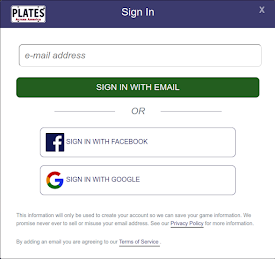
Plates Across America sign in page
New Sign In Screen

As we reconsidered redesigning Plates Across America®,, it dawned on us that the traditional email + password login scheme was not a good pattern for our game. People do not need the cognitive overhead of managing a password for a light, recreational game. They are more likely than not to forget it and then have to be subjected to the whole password reset email/awkwardness.

In general, passwords are quickly becoming obsolete with many sites always emailing you a "security code" anyway. Why not do away with the password altogether and embrace email as the authentication method?  Email has its security flaws for sure, but it is much better than it used to be, so much so that it is becoming universally used as an authentication method. If we were a bank, email alone would not suffice, but we are a game and we are not storing any important data for our players. 

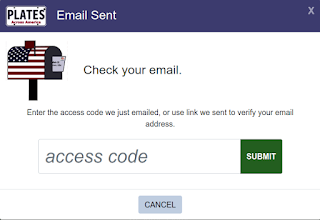
So we have ditched passwords at Plates Across America® and never looked back. The game should keep you logged in for a healthy amount of time, but if you move to a different device or restart your computer or browser, we'll simply email you a 6 digit access code to use to log back in. Keeps things simpler for us and our players.

security code screen
New Screen for the Access Code Entry


I hope our players agree that this is a simpler method, but send us feedback about your thoughts on the topic. Plates Across America ® 

Happy Travels!