Showing posts with label puzzle. Show all posts

Sunday, May 22, 2022

How to Get the Best Score in Plates Across America®

puzzle

In the Plates Across America® game, the quality of your answer to a puzzle will determine how far you travel: anywhere from 1 to 6 miles.  But what constitutes a "good" answer?  The simplest statement is: the more characters there are, the better it is. However, there are a host of more refined scoring rules that come into play. This article covers some of the more important ones and explains the rationale behind them.

Pluralization

Pluralizing a word adds 1 extra character without much additional cleverness. If one person comes up with a 7 character answer and then tacks on the "s", should they get the same score as the person that thought of a more "natural" (non-pluralized) 8 character answer? We think not, so a non-pluralize word will score higher than a pluralized word of equal length.

Lemmatization

Similar to the pluralization reasoning, there are a number of other ways to easily tack on extra characters. For the puzzle "SWR", the answer "swear" is valid but short and it does not require any more sophistication to pad some characters and make it "swearing". However, the word "steward" is longer than the word "swear" and deserves more credit, even if the person did not think to tack on an extra "ing" to that word. 

The process of taking a word and reducing it to it "base" form is called lemmatization. When scoring answers, we will prefer the "lemma", or the "root" word to shorter words with some simple extensions.

Compound Words

The game does not permit hyphenated words, though there is a fine line between these and compound words. For the valid compound words, we assign a slightly lower score than the other words of equivalent length. We believe that the person coming up with one long word should get more credit than a person that just tacks two short words together.

Summary

Though word length is the predominant means we use to measure the answer quality, we have rules in place to prevent rewards for padding an answer's length with trivial extensions.

If you have not played our game before, try it out here for free:

Happy Travels!


Sunday, May 15, 2022

Puzzle Difficulty in Plates Across America®

Puzzle Difficulty Comparison
If you have played Plates Across America® for even a little while, you will be well aware of the fact that not every puzzle is equal in difficulty.  

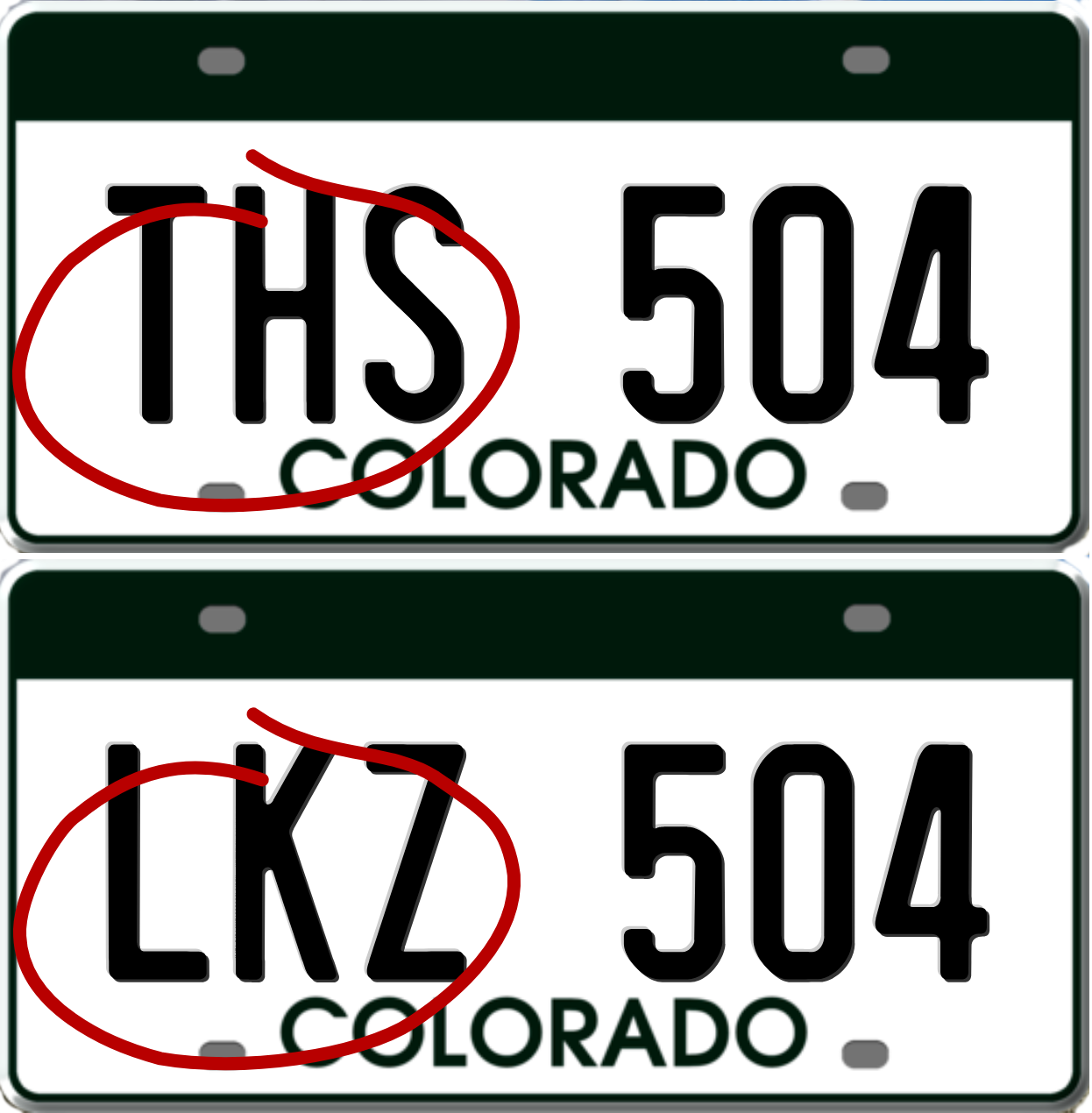
The puzzle "THS" is much easier to solve than "LKZ". If we showed only the hard puzzles, it would be a frustrating experience. Conversely, if we only selected the easiest puzzles, the game would not be very challenging and people would get easily bored.  

Therefore, the balance of the puzzle difficulty is an important part of the game play for us to get right. This article gives a few details about how the game determines which puzzles to show.

What Makes a Puzzle Difficult?

On seeing a puzzle for the first time, most people immediately are drawn to words with those letters near the beginning of the word. Secondarily, words where the puzzle letters are close together in the word tend to pop up in people's minds. Conversely, words where the letters are scattered throughout the word tend to be harder to find. For each of the game's puzzles we compute a "letter position difficulty" score which serves as one of the factors that determines a puzzle's complexity.

Among the early ideas we considered was that the more possible solutions the puzzle had, the easier it may be to solve. However, this is a flawed line of thinking because not all words are created equal. Even if the puzzle had only one possible solution, if that word was in everyone's common vocabulary, it might be relatively easy to solve. Conversely, a puzzle that has 100 solutions could be very hard to solve if all those words were relatively obscure.

We decided to use word frequency to gauge how common words are. This is based on looking at how often words appeared in large collections of text documents (e.g., how often the word appears across all the Wikipedia articles). We take these word frequencies across all possible solutions and derive a "frequency score" for the puzzle. This better represents how easy it will be for someone to come up with an answer rather than the shear number of possible solutions.  

We pre-compute the "letter position difficulty" and the frequency score for each puzzle and then blend those together to arrive at an overall difficulty score. It is this final difficulty score that determines how frequently the puzzle will appear in the game.

How Does the Game Pick the Puzzle?

With each possible of the possible 14,000+ puzzles, we assign a difficulty score to them as described above. We then group them into 6 difficulty level tiers from easiest to hardest. The puzzle selection is then done randomly, but with a two level selection scheme.

  • First, we randomly choose one of the 6 difficulty tiers. This is a weighted selection so that the easiest tier is chosen 50% of the time, the second easiest 35% of the time, then 9%, 3%, 2% and finally 1% for the most difficult puzzle tier.
  • Then, from within the tier, randomly choose one of its puzzles (uniformly selected).

In Closing

The puzzle selection scheme is an important part of the playability of the game, but it is fairly involved to determine the relative difficulties of all the game's word puzzles. We think we have struck a good balance in our game, but always looking to improve if you have suggestions for us.

If you have not already played, try our game and send us feedback about what you think:

Happy Travels!


Monday, August 10, 2020

Interesting Puzzle Stats

Plates Across America® puzzle

If you have played Plates Across America™ and understand how the game's word puzzles work, you might have asked yourself questions, like "How many puzzles are there?".  In this post, we try to provide some interesting facts about the underlying puzzle data. In case you have not yet played the game, we'll first briefly go over how the puzzles work, however you could also familiarize yourself with the game by trying the free demo here:


Puzzle Rules

A "puzzle" is three letters, where the order matters. A valid answer to the puzzle is a dictionary word in which those three puzzle letters appear and are in that same order. The letters do not have to be consecutive within the word and can appear anywhere as long as the ordering is not violated. Some examples:

    PuzzleValid Answers
    ABTabout, tabletop, bicarbonate
    IOLidol, airfoil, antisocial

Most important to the game is that (generally) the longer answers are worth more than shorter answers. The longer the answer, the further you travel with each puzzle. The goal is to try to cover the distance in a route with the fewest possible puzzles.

There are a few nuances to the scores assigned to the answers so that it is not always strictly that longer ones score higher. For instance, if you just add an "s" to the end of a word to pluralize it, that would have the same value as the non-pluralized word even though it has one more letter. The full run-down of all the scoring rules will be covered in a future blog post.

The Dictionary

The puzzles are derived from the words in the game's dictionary. We built this dictionary trying to cover the most common word usages. For example, though the dictionary does include a lot of medical terminology, it is not trying to be comprehensive to cover all the more esoteric words. 

Our dictionary is not perfect, which is why we provide an in-game feature to allow players to tell us when they find something we are missing. Here's a picture of the "Report Word" link we show in the game:

Suggest addition to dictionary

So, how big is our dictionary? As of this writing, it has 98,614 words. Every week, we add more as our players report words that should be added to the dictionary.

The Puzzles

All the puzzles we show in the game have at least one valid dictionary word as its answer. In theory, there are 26 * 26 * 26 = 17,576 different 3 letter combinations. However, not all these combinations have a matching word, e.g., "WZX". In the end, there are only a total of 14,863 puzzles in our game. 

Some other facts:
  • For the two example puzzles given above, ABT has 1,045 matching words and and IOL has 2,075.
  • The puzzle with the most matches is IES with 18,080 different matching words.

The Answers

If you add up all the valid answers across all of the 14,863 puzzles, you would get that there are 8,071,767 total answers.  That means that the average puzzle has 543 valid answers.

Other facts:
  • With a dictionary of 96,614 words, this means that the average word matches 82 puzzles.
  • Since a valid answer must contain at least 4 characters, the fewest puzzles a word can match turns out to be 3. e.g., The word "pool" only matches POO, POL, and OOL.

Parting Thoughts

We hope you found this small sample of game statistics interesting.  If you have questions or think of anything related to the game's data that you are interested in, please let us know.

Happy Travels!


Saturday, July 25, 2020

Need a Shot of Adrenaline? The Race Game Puzzle Timer

The most controversial feature (as measured by our company's internal squabbles) was the addition of the puzzle timer.  Should a player be allowed as much time as they want to come up with an answer, or should we put a cap on how much time they have?

Plates Across America® timer
The designer that came up with this idea felt that a timer was essential to improving the game play. She felt like tough puzzles was causing her to get frustrated. Her personality is such that she was not willing to give in to defeat, so would continue to stew on an answer and get more and more frustrated.  She felt that it would be a relief to be forced to move on after some time.

On the other hand, many of our early test players enjoyed the more leisurely pace of the game and having time to think. Since the game has you traveling the country, shouldn't you be in control of when you travel, where you go and how fast you get there?

Both of these "camps" had very good arguments for their positions.  We were not going to add the feature until we were completely convinced it was important, so we sat on the idea for a long time, reconsidering it often. This debate began prior to our initial release, and went through many months after our initial launch (March of 2020). 

As we discussed in a previous article, when we launched the game, we only offered a single-player option, then began working on the two-player "Race" game a couple months after launch. The puzzle timer question lingered.  However, about half-way through the design of the Race game it had become fairly clear that the timer was going to be essential for the two-player game.

Why the Timer Matters

Suppose you like the game, but since you have a busy life, the amount of game play time you have is limited. Suppose you have an independently wealthy friend who also likes the game. With much more leisure time on their hands, your friend will have a distinct advantage if they race you: they can contemplate answers for much more time than you can.  
Plates Across America® timer expired

The timer levels the playing field, while also putting a cap on how long a game is going to last. Thus, it provides both fairness and predictability, both of which we felt were essential in the race version of the game.

Once we committed to the design and engineering effort to add the timer feature for the two-player game, we had no choice but to revisit this question for the single player game. We ultimately decided to leave the timer out of the single player game. Since our internal factions were so divided, and since we felt the general population could have similar sentiments, providing the choice of un-timed single player mode and timed race mode could keep both types of players happy.

Pausing the Timer

Have you ever tried to interrupt someone while they are in the middle of a time-based game? The reaction you get can be a function of the person's personality, but it can often be less than civilized.  From the player's perspective, life does have a way of making "things" happen, and you might need to interrupt the game to take care of such "things".  It would be a better game if you did not have to choose between tending to life and winning a game.
Plates Across America® timer paused

To address these concerns, we added the ability to pause the game.  This game pause does not happen immediately though, but only after the current puzzle.  This was done to guard against a player using the pause function to gain an unfair advantage. We are not 100% enamored with the current design of this feature, so we may revisit this, but for now it provides the main pausing function we felt we needed.

How Much Time?

Once we committed to adding a puzzle timer, the obvious question is, "How much time should a player get for each puzzle?"  Originally, we had no idea.  We started with 25 seconds and this nearly led to riots.  If you are an adrenaline junkie, this might be your sort of game, but we unleashed 25 seconds on a set of beta testers who were more of a meticulous, laid back mind-set and who were also used to the original version and having all the time in the world. It was a brutal culture shock for them.

The most obvious place to go from there was a 1 minute timer. This turned out to be a fair amount of time: enough to let you think and reconsider, but not so much time that you do not feel any time pressure.

Adrenaline Anyone?

A final note about that stress-inducing 25 second timer we experimented with: we are contemplating making this a game option. We would call it something like "Sprint" mode and it would definitely liven things up a bit. We are not sure how much demand there might be for something like this, so if you think this would be of interest, please let us know.


Happy Travels!

Sunday, March 29, 2020

Notes from Our First Release of Plates Across America®

We reached an important milestone today in the development of the Plates Across America (TM) game. With today's release, we added a very useful interactive free demo and we've completely redesigned the user interface.  Although the first "soft release" happened a few weeks back, today's release is the first one that is ready for more than just friends and family. Feel free to check it out here:
Plates Across America® travel
Game Screenshot

Plates Across America Free Game Demo

For those that might be interested in the game's history, the basic premise on the word puzzles stretches back years. This seemed novel and catchy enough that we saw potential. Somewhere around March 2019, the word puzzle idea was combined with the travel theme and the game started to take shape. Initial prototypes and algorithms were developed in the ensuing months, and work toward building the web-based version started in the Summer of 2019.

The web-based version is just the starting point to help us get up and going quickly so we can refine the ideas. Once we feel it is refined enough, we will be creating mobile app versions.

If you try our game, we would love to get your feedback.

Plates Across America® word game